
How to get more event RSVPs: the 3-touch follow-up your team runs together

Oniloo
Jun 19, 2026
You sent the invitation three weeks ago. Half the list has not replied. The caterer wants a number by Friday, and the honest answer is that you do not have one. This is the quiet stress of every event: the guest list is full of "maybe," and the date keeps coming.
Chasing RSVPs is not about nagging harder. It is about a short, predictable sequence, and about your whole team seeing the same list while you run it. Here is how to get more event RSVPs without losing your evenings to follow-up.
Why do event RSVPs stall?
People do not ignore your invitation because they do not care. They open it on their phone, mean to reply later, and later never comes. A single ask, sent once, leans on the guest to remember. Most will not.
The second failure is hidden, and it happens on teams. Responses land in different places: one in your inbox, one in a co-organizer's DMs, one scribbled after a phone call. Nobody holds the real number. So two of you chase the same guest who already said yes, a confirmed family gets a reminder that makes you look disorganized, and the headcount you give the caterer is a guess. The fix is not more effort. It is one sequence and one shared list.
The 3-touch sequence that fills seats
Three contacts, spaced out, each with a clear job. That is the whole method.
Touch 1, the save-the-date (4 to 6 weeks out). Short, warm, no pressure. Date, place, and one line on why it matters. You are not asking for a decision yet, you are claiming a spot in their calendar before it fills.
Touch 2, the real invitation with a deadline (2 to 3 weeks out). This is the ask. Give them everything they need to decide in one read, and name a reply-by date. "Let us know by the 20th" converts far better than an open-ended "let us know." A deadline gives the reply a home in their week.
Touch 3, the gentle final nudge (3 to 5 days before the deadline). Send it only to people who have not answered. Keep it kind: "Still hoping to see you, can you let me know by Friday so we can confirm catering?" Naming the reason makes the nudge feel considerate, not pushy. This last touch is where the no-replies turn into numbers.
Two rules make the sequence work. Stop contacting anyone the moment they reply, and never send touch 3 to someone who already confirmed. Both depend on one thing: knowing, in the moment, exactly who has answered.
Run the sequence as a team, not a solo inbox
A spreadsheet can hold names. What it cannot do is tell your co-organizer, in real time, that you already nudged the back half of the list this morning. That gap is where the double-chasing and the wrong headcount come from.
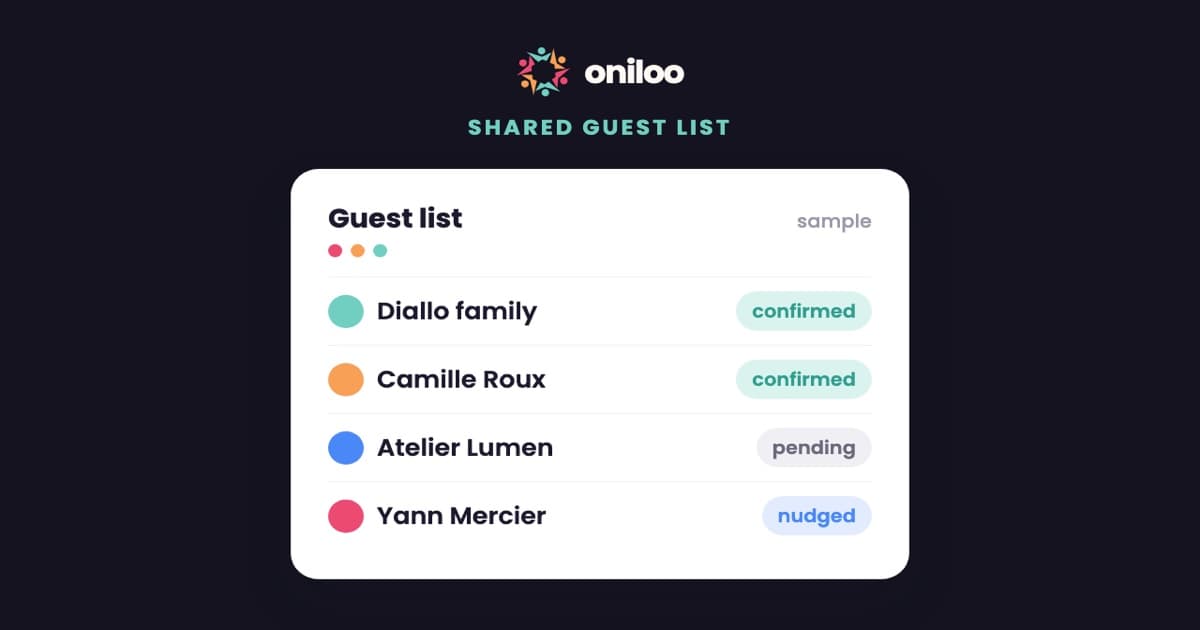
This is the part Oniloo is built for. Your guest list lives in one shared place, and every organizer on the event sees the same statuses: confirmed, pending, declined. When you mark a final nudge sent, your teammate sees it without a single message passing between you. When a guest confirms, the count everyone plans against, catering, seating, badges, updates for the whole team at once. Nobody chases a guest who already said yes, and the number you give the caterer on Friday is the real one, not a guess.
That is the difference between three people working a list and three people working against each other.
Run the 3-touch sequence on a list your whole team can see, and "maybe" turns into a headcount you can trust.
Join Oniloo's free beta: signup