
Event vendor brief template: the six fields that prevent most day-of surprises

Oniloo
Jun 30, 2026
The caterer showed up without a trolley. The AV crew blocked the loading bay catering needed for forty-five minutes. The florist left before the tables were dressed because nobody told her the timeline had shifted. None of these were bad vendors. They were all cases of missing information.
A vendor brief is not a formality. It is the document that replaces the phone calls, the assumptions, and the frustrated text at 8 a.m. on the day. Here is the event vendor brief template that actually works, and more importantly, why each part of it matters.
What is a vendor brief, and why does verbal confirmation fail?
A vendor brief is a short written document you send each vendor before the event, telling them exactly what you need, when you need it, where to be, and how to reach the right person. It is not a contract (that is separate) and it is not a long email chain. It is a single, clean reference they can print or open on their phone on the day.
Verbal agreements are where expectations diverge. Not because anyone is dishonest, but because a conversation leaves each person with their own mental summary. You said "around noon." They heard "noon means I arrive at noon." You meant "noon means the setup is done and we go live." That gap costs you an hour on a day you cannot give back.
Confirmation in writing forces both parties to agree on the same specifics before the day arrives, not discover the mismatch during load-in.
What should a vendor brief include?
The six fields below cover the things that most commonly go wrong when they are missing. Each one exists to prevent a specific failure, not because it sounds thorough.
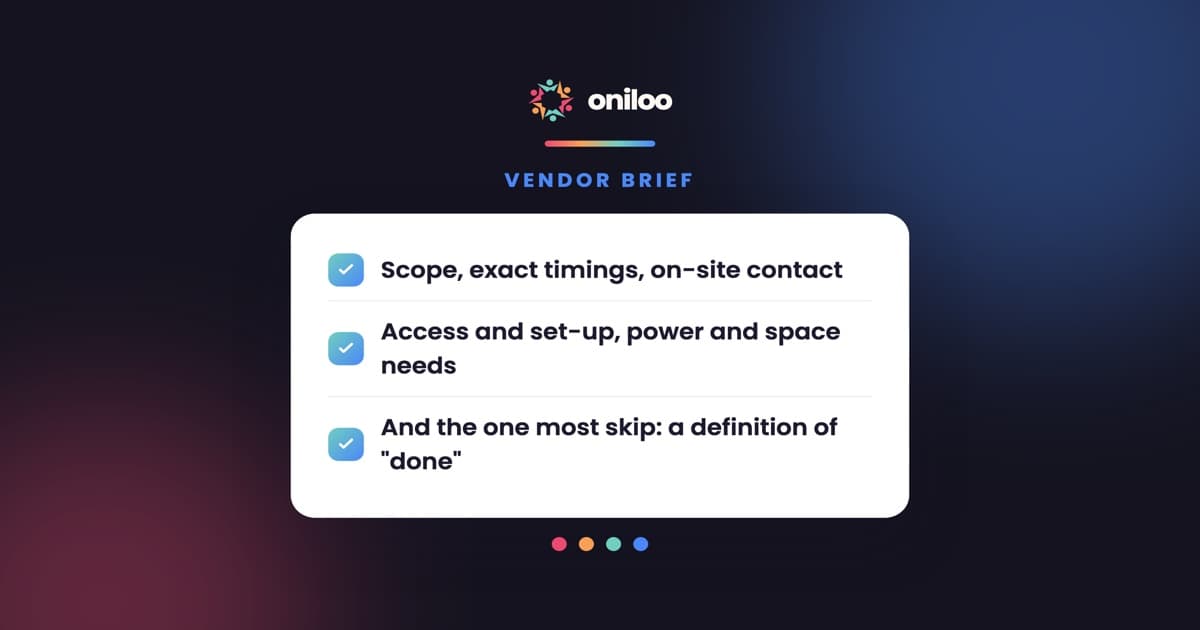
1. Scope: what exactly are they delivering?
Do not assume a vendor's scope matches your mental picture. Write it out: number of tables, chairs, and linens for the caterer; number of microphones, screens, and which inputs you need for AV; flowers for which tables only, or the full room? The more specific you are, the less they interpolate.
The failure when this is missing: the vendor delivers what they assumed you meant, and it is not what you needed. By the time you notice, it is too late to fix without cost.
2. Exact timings: arrival, setup, go-live, teardown
Not "morning." Write the actual times. Arrival at 09:00. Setup complete by 10:45. Event starts 11:00. Teardown begins 18:30. Out of the building by 20:00.
This matters even more when you have multiple vendors on site. Catering setup and AV setup need different parts of the same space. If their windows overlap without a plan, they conflict. A parking bay big enough for one van is not big enough for two.
The failure when this is missing: the AV crew and the catering team try to occupy the same corridor at the same time, one of them falls behind, and the setup is not finished when the first guests arrive.
3. On-site point of contact: who they call, not who you are
This is the most underused field in any event vendor brief template. Give the vendor a name and a mobile number for the person who will actually be reachable on the day, not your general email address, not your own number if you will be handling thirty things at once.
Assigning a single area contact per vendor category, catering to one person, AV to another, front-of-house to a third, is how you free yourself to run the event rather than being the single answering service for every arriving truck. A vendor who knows who to call does not have to chase you.
The failure when this is missing: every vendor defaults to calling the lead organizer, who is mid-conversation with the venue manager when the florist needs to know which entrance to use, and who cannot give anyone a clean answer.
4. Load-in and load-out logistics: where, when, and how
Delivery entrance or main entrance? Lift available, or stairs only? Parking for a large vehicle, or a strict no-parking zone? Shared loading bay, or a window they must book? Is there a freight elevator? Is there a building security check-in?
Write all of this in the brief. The vendor has done events before but has not done your venue before.
The failure when this is missing: the van arrives at the main entrance, security sends them away, the driver circles the block looking for a loading bay nobody told them about, and they arrive thirty minutes late to a window that was already tight.
5. Power and space requirements
AV and catering both need power, and venues have circuit limits. If two vendors plug in simultaneously in the same part of the room, you get a tripped breaker in the middle of setup. Know what each vendor needs: voltage, number of outlets, maximum draw. Ask the venue what each circuit can handle. Match the two before the day.
Space requirements matter too: a DJ needs a certain footprint, a photobooth needs a wall, a caterer needs a working area away from the guest flow. Sketch this out in the brief so there are no surprises when everyone arrives at once.
The failure when this is missing: a vendor arrives to find the space already taken, or plugs in and trips a circuit that takes out the adjacent vendor's equipment.
6. Definition of done: what "finished" looks like
This is the field most briefs skip, and it is where clean endings go wrong. Does "done" mean the vendor packs up and leaves? Or does it mean they stay through a specific moment, tidy the space to a specific standard, and only leave once a named person signs off?
The florist who left early did not do so out of laziness. Nobody told her what "done" meant for this event. She finished what she was asked to do and went home.
Write it out: "Your work is complete when all centerpieces are in place, the venue contact has signed off, and you have cleared your materials from the loading area." That is a definition. "Set up the flowers" is not.
The failure when this is missing: the vendor considers themselves done before you do, leaves, and the thing that needed one more step is not there when you need it.
How do you hand off the brief so nothing falls through?
Writing the brief is half the job. The other half is making sure it actually reaches and is read by the right person, with enough time to raise questions.
Send it at least a week before the event, not the night before. Include a reply-by date and a question to answer: "Please confirm you have received this and flag anything that needs clarifying." A vendor who has read and acknowledged the brief has fewer surprises.
Attach the brief to the signed contract rather than sending it separately. That way both parties have the same version in the same thread.
What is a day-of contact sheet, and why does it sit alongside the brief?
The vendor brief goes out in advance. The day-of contact sheet is what the team carries on the day itself: every vendor's on-site name, mobile number, and arrival window in one document. One A4 page, or one shared file on a phone.
This is the companion to the brief. The brief tells the vendor everything they need. The contact sheet tells your team who to reach when something changes, without hunting through an inbox full of email threads.
Make it simple: vendor name, category, on-site contact name, mobile, arrival time. Keep one version current and make sure everyone on your team has it, not just you.
If your team works from shared files, keeping the contact sheet in the same place as the brief and the rest of the event documents means nobody is texting you at 07:45 asking for the caterer's number.
What makes this template different from a generic checklist?
The difference is that each field maps to a specific failure mode. Most vendor brief templates tell you to "confirm the details in writing," which is correct but not useful. This one tells you what happens if each field is missing, so you know which ones actually matter for your event and which you can simplify.
A solo organizer running a small private dinner does not need a circuit diagram. They do need the on-site contact and the definition of done, because those two fields are the ones most likely to cause a problem on the day at any scale.
Use the six fields as the starting point, then adapt them to your event. The brief is a tool, not a form.
A vendor who knows exactly what you expect, when to arrive, where to park, who to call, and what done looks like is a vendor who can do their job without needing you. That is the whole point.